


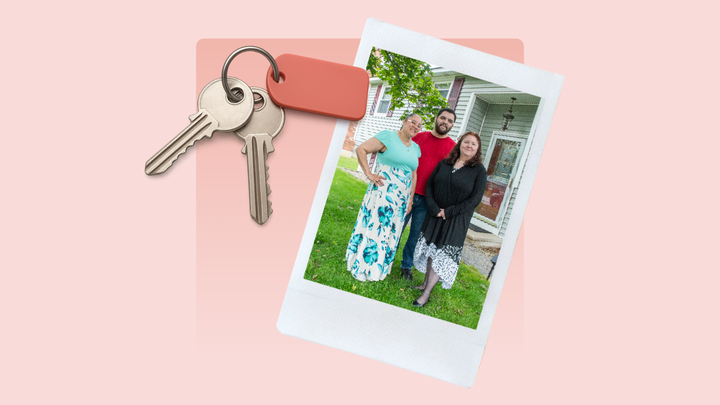
Cross Photography, illustration by Clay Laucella/Bankrate
For some, southern New Hampshire is the ideal three-day jaunt up from Boston or autumn leaf-peeping destination. But for Ebony Martin, it’s home.
Though the 42-year-old now owns a house in Manchester, NH., there was a time when the market was so competitive it felt impossible to elbow her way in. Martin had been looking for over a year on her own, “only finding little shacks that needed to be completely renovated in order to live in,” she says. At that point, she felt ready to give up.
Setting the scene on homebuying
Manchester holds two unique titles: the most populous city in New England north of Boston and the hottest housing market in the country. A February 2026 report from Realtor.com ranked Manchester at the top of its top 20 sought-after real estate hubs, with an average of 3.4 viewers per property. The typical Manchester home sells in 36 days, more than a month faster than the rest of the U.S.
Another report from New Hampshire Realtors found that in February 2026, the statewide median home sale prices reached $525,000 — the 73rd consecutive month sales prices have risen. The Granite State isn’t the only one where buyers are feeling pushed out: a 2025 Bankrate report found that anyone making the median income is effectively priced out of 75% of the market.
New Hampshire is a challenging market. Affordability in the region is impacted by people coming from other states, like Massachusetts, and buying second homes.
— Michelle Caraccio, resource development director of NeighborWorks Southern New Hampshire
Behind her homebuying experience
When she fled her abusive ex-husband’s home, Martin had nothing but a suitcase full of clothes. From there, she transitioned into government-assisted housing — or Section 8 — renting a three-bedroom apartment with six other tenants.
But Martin wanted a more permanent place to land. “I’ve never really owned my own thing before,” she reflects. “My goal was to not be on Section 8 and food stamps forever.”
She started house hunting for properties in the range she was preapproved for, though her options were limited. Martin kept getting outbid by buyers with higher purchasing power, even on the smaller homes in her price range that needed a gut renovation. As the home search stretched on, she began to worry she might not find what she was looking for.
Martin started writing letters to potential sellers, telling them that the home would be her and her family’s primary residence — not a second house or investment property. “It would be a home,” she’d write. “We want to live here to be here.”
The letters didn’t work. To afford her home, Martin needed to boost her purchasing power. With a bigger budget, she’d have a better shot in the competitive market. Around the same time, the building Martin’s mother rented in for more than two decades was sold. Now, she also needed a new place to live. In September 2024, the mother and daughter pooled their incomes together to increase their budget and bring more homes into the mix than Martin was able to afford alone.
They also went through a homebuying education program and one-on-one counseling with NeighborWorks, a national network of more than 250 affordable housing nonprofits. In two months, the pair was able to close on a house in their elevated price range, a two-bedroom home with a basement large enough for an in-law apartment.
An expert’s take
Evelyn Rivera, the HUD-certified housing counselor Martin worked with, says that first-time homebuyers in southern Manchester are playing a rigged game. “We have first-time homebuyers competing with people who might have retired and sold their bigger homes,” she adds. “They have the big city salaries and they can afford to purchase in our state.” For folks looking to break into tighter housing markets, she advises getting educated on the homebuying process — either on their own or through a nonprofit organization. “[Housing professionals] truly appreciate people who have been educated about the buying process,” she says.
Her homeownership dream
Though ownership isn’t always easy — clearing her driveway of heavy New Hampshire snowfalls isn’t her favorite activity — it’s become a point of pride. “It makes me feel accomplished to be able to take care of my own space and my own home,” she remarks.
Why we ask for feedback
Your feedback helps us improve our content and services. It takes less than a minute to
complete.
Your responses are anonymous and will only be used for improving our website.
Help us improve our content
Read the full article here